



Itinerant tourism is experiencing a historic moment, representing a great opportunity for both private entrepreneurs and municipalities, which are increasingly able to manage these spaces thanks to an evolving regulatory framework.
The dynamism of the sector is evident, but the success of a motorhome area is not guaranteed. Poor planning in the design phase can seriously compromise the return on investment and user satisfaction, transforming an opportunity into a source of problems and unforeseen costs.
This article is a practical guide to avoiding the most critical mistakes in the design of a motorhome area, based on the experience accumulated in the design and commissioning of dozens of sites, ensuring that your project is born on a solid, functional, and profitable foundation.
Sign up for our newsletter so that you don’t miss any of our latest news
Mistake 1: Underestimating hydraulic and sanitary infrastructure
Water management is the pillar of any motorhome area. Mistakes made at this point are not only the most difficult and expensive to correct, but also carry the greatest sanitary, environmental, and legal risks.
1.1. A wrong connection that can cost a lot
A very serious and often invisible execution error is connecting the grey water drain to the stormwater drainage system instead of the sanitation network. This mistake generates “serious hidden pollution and a legal risk,” as it directly discharges water that is not clean into the environment. Contrary to what might be thought, grey water (from showers and sinks) contains soaps, organic residues, and the chemicals used for tank treatment, which must be treated.
To avoid this confusion during construction, it is useful to remember a key physical distinction: the cleanouts of the sanitation network usually have a smaller diameter (15 cm or less) than the inlets of the stormwater drainage system.
1.2. Cross-contamination risks
The protection of public health requires a clear differentiation between potable water intakes and those intended for cleaning the chemical cassette. A failure at this point can lead to contamination of the supply network. To avoid this, the AGA (Galician Motorhome Association) good practice guide specifies that the cassette cleaning tap must be push-button and, crucially, without a thread. This physical prevention measure prevents a user from connecting a filling hose to this tap, avoiding cross-contact.
Furthermore, as good engineering practice, it is recommended to install the cleaning tap at a lower height than the potable water tap to reinforce visual and functional differentiation. Finally, it is essential to install Backflow Preventers on the potable water supply line. These devices prevent potentially contaminated water from a hose from flowing back into the public network in the event of a pressure drop, thereby protecting the general supply.
1.3. Ignoring the climate: the problem of frost
In low-temperature areas, underestimating the risk of freezing leads to costly pipe bursts. Traditional passive insulation is often insufficient to protect exposed water connections and service terminals.
The specialized engineering solution for motorhome areas is active protection. Installing self-regulating heating cables in the pipes is the most robust measure to guarantee service continuity during the winter. Although it represents an initial investment, it is fully justified by avoiding the high costs of burst repairs and the loss of income due to the area’s inoperability.
In short, a well-designed hydraulic infrastructure is not an expense, but a direct investment in public health, environmental legality, and the reputation of your area.
Mistake 2: Neglecting the terrain and accessibility
Errors in land engineering and space dimensioning directly affect user comfort, safety, and the durability of the infrastructure itself.
2.1. Sloping pitches and deficient surfaces
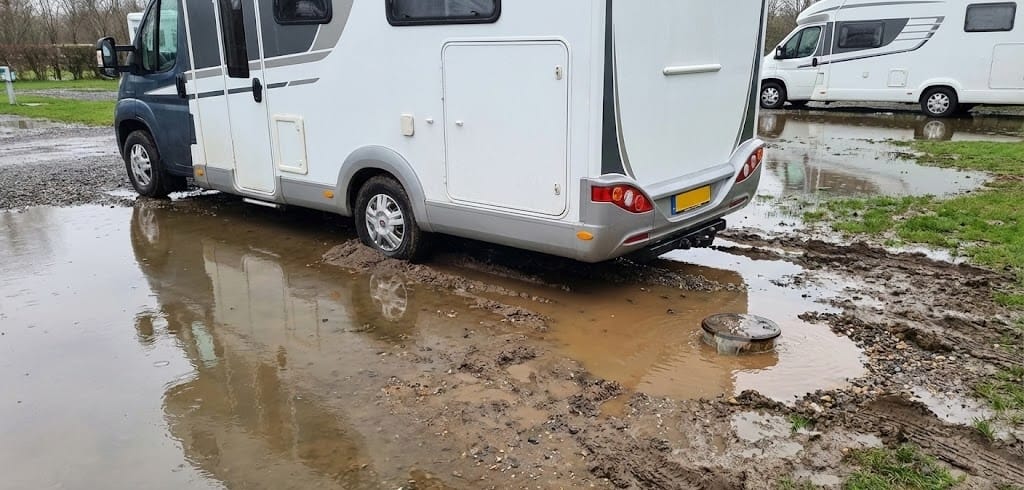
The lack of flat surfaces is one of the most common and justified complaints from motorhome users. A slight slope, almost imperceptible when walking, becomes a major discomfort when sleeping, eating, or simply being inside the vehicle.
This problem is aggravated when combined with insufficient drainage. Stagnant water weakens the surface, which ends up deforming and sinking under the weight of the vehicles, which not only exceed 3,500 kg but in some cases exceed 10 or even 12 meters in length.
2.2. Inadequate dimensions
It is a common mistake to dimension pitches to the legal minimum (e.g., the 40 m² established by some regulations) without considering the actual functionality the user needs. The motorhome user requires enough space to “live outdoors,” which means being able to deploy an awning, chairs, and a table without invading the space of others.
A practical estimate is to consider about 80 m² per vehicle (including roadways and common spaces) to guarantee comfort and maneuverability. Equally crucial is ensuring a clear height clearance of at least four meters at all accesses and pitches for the safe passage of large vehicles.
In conclusion, investment in correct terrain engineering translates directly into user comfort, infrastructure durability, and ultimately, positive reviews that attract more travelers.
Mistake 3: Failing to foresee infrastructure for future technology
A critical design error is failing to install the necessary physical infrastructure for future technological automation and management. The sector’s trend is clear: automation of access control with barriers and license plate recognition (LPR) cameras, digital check-in processes, and service management through smart terminals.
This foresight is key to ensuring a smooth and frictionless flow of travelers, a decisive factor for customer satisfaction in high-turnover areas.
All these systems require not only electrical power but also data and communications cabling. The cost of installing reserve (empty) underground conduits during the civil works phase is marginal. However, if this foresight is omitted, any future technological implementation will require costly excavations, breaking the surface and multiplying the costs.
In short, foreseeing reserve conduits is one of the lowest-cost decisions with the highest future return, protecting the initial investment against technological obsolescence.
Mistake 4: Designing annoying and polluting lighting
The lighting of a motorhome area must find a perfect balance between safety and nighttime comfort. A frequent mistake is causing excessive light pollution, a particularly serious problem for users of camper vans with canvas pop-up roofs, whose quality of sleep is directly affected, as the canvas offers more limited light protection.
To create a safe but rest-respectful environment, good lighting design must follow three basic principles:
Use Full Cut-Off luminaires: They must direct 100% of the light towards the ground, avoiding any projection towards the sky or the sides.
Install low-height poles: The goal is to functionally illuminate the path and service points, not the entire enclosure.
Use lights with a warm color temperature: A temperature below 3000K is recommended to reduce the impact of blue light, which is more disruptive to sleep cycles.
In summary, a respectful lighting design not only improves the quality of rest but also positions the area as a comfortable and sustainable destination, a differential value increasingly appreciated by the camper community.
Conclusion: The key is expert planning
Avoiding these design mistakes is fundamental for the long-term success of a motorhome area. The conclusion is clear: investing in quality planning from the start, with specialized technical advice from the project’s conception, translates directly into lower maintenance costs, greater user satisfaction, and ultimately, the economic viability and reputation of your project.
Are you ready to take the first step?
Avoiding these design mistakes in your motorhome area prevents future problems, but its true potential is unlocked with smart management from day one. Solutions like TripStop not only automate daily operations (traveler registration, access control, supplies) but also allow you, even in the project phase, to present a digital, sustainable business plan prepared for the demands of today’s traveler.
If you want to ensure the success of your project, contact the TripStop team to receive support and turn your vision into a reality.
See more in our blog.