


In many tourist towns, motorhome arrivals are concentrated into a few weeks of the year and into the same few places. The usual way to bring order to this is to set up a dedicated area, but as soon as the project is on the table a very practical question comes up: who takes care of municipal motorhome area management when the council has no staff to run it?
Today an area can run on its own: travellers arrive, register, pay and drive in without anyone needing to be at the entrance.
📌 In this article you’ll see why organising motorhome tourism has become a priority for many councils, how an area that needs no staff works, and what Llanes (Asturias) has done to expand its own.
Why organising motorhome tourism is a priority
The underlying problem is a lack of space. In an interview in Revista DGT ↗, the president of ASEICAR estimates that Spain is short of around 2,000 motorhome areas, with the biggest gap along the coast. He also points to the contrast with France, where practically every tourist town has a space for these vehicles.
The pressure is felt above all in high season, in coastal towns whose population multiplies over the summer. When motorhomes have no place designed for them, they end up competing for parking with residents and visitors. A well-planned area brings these vehicles together in a suitable space and improves coexistence.
The real challenge: municipal motorhome area management
Building the area is only the beginning. After that, vehicles need to be let in, stays need to be charged for, travellers need to be registered as the law requires, visitors from other countries need looking after, and someone has to check that nobody stays longer than allowed. And all of this at any time of day.
For most councils, especially those with few staff, this daily work cannot fall on municipal employees. That is why, when a municipality starts exploring the idea of an area, it is worth thinking from the outset not only about the construction work but also about how it will be managed day to day.
How a motorhome area works without staff
An automatic motorhome area moves the tasks that used to require someone at reception onto the traveller’s mobile phone:
📱 Arrival and registration. The traveller scans the QR code on the entrance panel, enters their details and pays for the stay from their phone.
🚧 Access control. The barrier or gate opens automatically for vehicles whose stay has been paid, which keeps the spaces rotating.
🧾 Legal compliance. The traveller registration required by Spain’s Royal Decree 933/2021 is done automatically, and invoicing is ready for Verifactu and TicketBAI.
🌍 Support in several languages. Area information and traveller support are available in 9 languages.
📊 Data for decision-making. The council knows the area’s real occupancy and can plan with reliable information.
You don’t need to automate everything at once. You can start with registration and payment by mobile phone, and add access control or the management of utilities such as water and electricity later on.
The Llanes example: more spaces, no extra staff
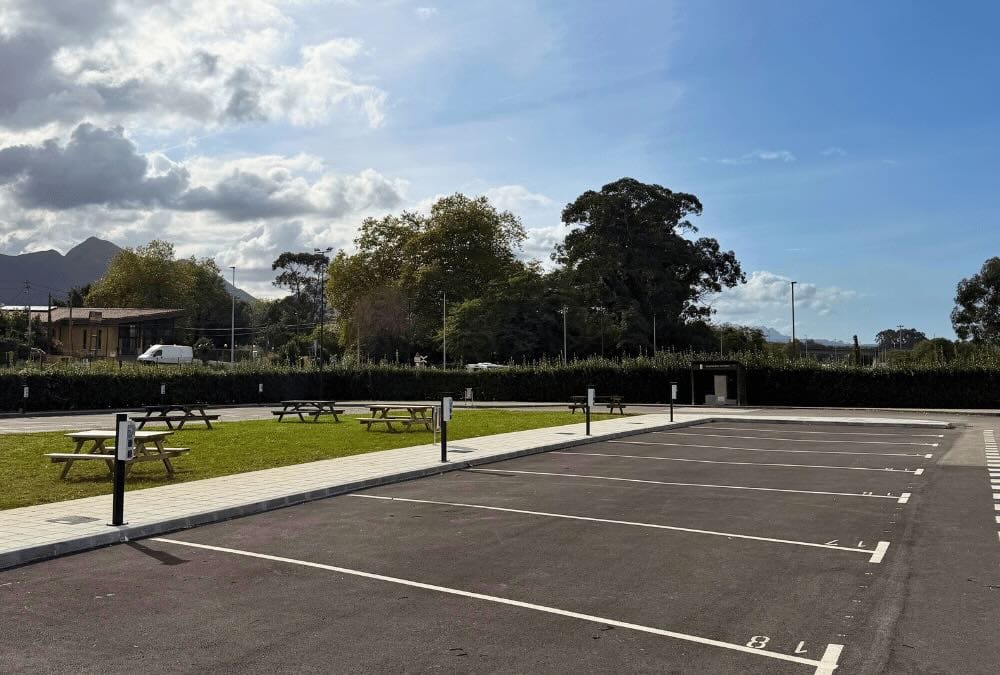
Llanes (Asturias) has just expanded its special reception area for motorhomes in transit, which goes from 19 to 30 spaces. As reported by RTPA ↗, the big new feature is that booking and paying for the stay, up to a maximum of 48 hours, are done through a mobile app or a website.
The expansion, in which the council has invested close to €140,000, also includes new access barriers, a surveillance system with two cameras and information signs in several languages.
TripStop manages the area’s access control. On arrival, travellers scan the QR code, register with their vehicle’s number plate, pay, and the barrier opens by itself. In the report, several travellers described it as a quick and simple process, even for those who don’t speak Spanish.
What is interesting for other municipalities is the division of roles: the council decides where to invest and what its area is like, while the day-to-day running of access, bookings and payments works autonomously.
🚐 See all the information about the Llanes motorhome area on TripStop.
Conclusion
The shortage of areas and the pressure of high season make organising motorhome tourism a necessity for many municipalities. But an area only does its job if it can be managed without adding to the council’s workload. That is why the management model should be part of the project from day one.
If you are starting to look into the subject and want to know how it would fit your municipality, discover our motorhome area management solutions: we help you define the model that best suits your needs.